
Celebrating 10 years: My creative story as a linocut artist and designer

On 1st June 2026, I celebrate ten years in business, a milestone that has prompted me to reflect on the creative journey that brought me here. Looking back, I can see how my work has continually evolved, from a childhood as an aspiring maker to a fashion and homeware designer, and back to my roots: working with my hands and building a creative business.
Today, my practice centres around linocut printmaking, creative teaching, and now writing my first book.
This blog is a place to celebrate that journey, the lessons learned, how I’ve adapted to the challenges I’ve faced, and the joy of returning to the kind of hands-on creativity that first inspired me.

Growing up: A childhood of making things
I’ve always loved making things and being creative. My favourite phrase was, and still is, “I could make that”. If I don’t know how to, I’ll certainly have a go.
Sewing, crafts and baking were my biggest interests. In my early teens, I made soft toys that I would sell to a local gift shop opposite Shakespeare’s birthplace in my home town of Stratford-upon-Avon. I still have the costing and sales book. I kept track of it all! An early entrepreneur in the making!! I went on to make all my own clothes.
As a child of the 70s, I was greatly influenced by Tony Hart and Blue Peter. I loved making a Sindy doll clothes shop filled with clothes I’d made too. I also liked drawing. I would spend hours sketching Disney Characters. Ironically, I ended up working for Disney!

Studying design and fashion
My strongest subjects at school were maths, sewing, art and the sciences. I didn’t have a particular ‘I want to be something’ when I was growing up. I just knew I liked making things.
I took a two-year National Diploma in Design, specialising in fashion design in my second year. I excelled at the pattern-cutting and making part of the course and created a wedding dress collection for the end-of-year show. I then moved to Southampton to study for a two-year Higher National Diploma in Fashion Design. I graduated in 1991 at the age of 20. I have been lucky enough to be working as a designer ever since.

Designing for well-known high street brands
My tutor recommended me for a junior textile design job in London. I had been hopeless at textile design at college and wasn’t a city girl at all. I did need a job, though. I applied, did the application design project for my second interview and got the job!
So, at 20, I moved to London. It was a steep learning curve, and I was way out of my comfort zone. Back then, textile design concepts were still painted by hand in gouache. Each colour was mixed to the exact Pantone shade of the retailer's palette. This is where I developed my strong eye for colour. I also learned how to create textile patterns and graphics.
From 1991 to 2005, I worked my way up the career ladder in fashion, textile design and homeware. I designed for high-street retailers such as The Arcadia Group, Freeman’s catalogue and Disney. You may own something I’ve designed!

A change in direction - Homeware design
After 15 years in fashion design, I felt the need for change. I’d had enough of fast fashion and wanted to move into designing homeware. That seemed easy, as I had all the transferable skills, but I met a lot of resistance from recruitment agencies.
I was contacted about a new role being created at Disney Consumer Products. As someone with a broad, adaptable skill base, I fit right in. I went on to set up the Pan European Creative Managers role for Disney Home and Disney Baby. My role was to develop the creative direction forDisney characters and films. I worked with the local European teams to create a cohesive look across Europe. Developing ranges on everything from Disney Princess bedding to Winnie the Pooh lunch boxes was great fun.

In search of more meaning: Travel and designing for Fair Trade
I’d climbed the career ladder and had a successful career, but something was missing. I longed to do something more meaningful and give back. I also wanted to travel more as I hadn’t taken a gap year after graduating.
In 2015, I quit my job to go backpacking around Southeast Asia for a year. I spent four months in Cambodia volunteering for a Fair Trade company in Phnom Penh.
They had three gift shops and worked with an in-house team of artisan makers, as well as small producers and craftspeople across the country. I worked with them to develop their ranges and help improve their marketing. I loved every minute of it.

Moving to York: A happy accident
Returning to the UK, I didn’t want to go back to city life or the rat race in London. At 35, I moved back in with my mum and dad to look for a design job in Fair Trade. It wasn’t easy, as most companies are pretty small.
Months of cold calling led me to a design vacancy at Shared Earth in York. I came up for an interview and got the job. A few weeks later, I moved up here without a sense of where this new chapter in Yorkshire would take me.
Shared Earth was one of the UK's largest fair trade retailers and wholesalers. We developed ranges with over 30 producers, craftspeople, and artisan makers worldwide.
I became their Head of Design, developing homeware and gift ranges. I also created a fresh, cohesive look for Shared Earth's branding and marketing materials. Communicating how the products were made, by whom, and the impact of the purchase was very important.

Not everything goes to plan
The recession hit, and many of the senior management roles were made redundant.
I put up a “help, I need a job” post on Facebook, and a few days later I had an interview for a maternity-cover graphic design role at a design agency. I got it. Phew! Not being a formally trained graphic designer, I felt I had a lot to prove, which was another steep learning curve.
When that ended, I was looking for work again. The design world is very London-centric, so it’s not easy.
A role emerged at George Home at Asda, designing home accessories and lighting. It wasn’t right in my heart, but I had bills to pay. I remember crying when I got the job. It meant I was back designing in the commercial world again. Don’t get me wrong, it was a brilliant role.

I became the Design Manager for the Cook and Dine range. We designed everything from the graphic illustrations on mugs and tableware to all-over prints on tea towels. They hadn’t had a designer on the team before, but I enjoyed the challenge. I worked with a team of in-house designers, freelancers, buyers and merchandisers on multiple ranges each year. We developed thousands of products each season.
Sewing the seeds of change
The corporate world was all I’d ever known. I’d already tried to escape the rat race once before but had got sucked back in.
I couldn’t imagine working in highly stressful head-office environments for the rest of my career. In design manager roles, I had lost sight of hands-on design work. My time was spent on strategic direction, planning what the trends and ranges would look like, and overseeing designers or briefing freelancers to bring them to life. Plus, there are lots of meetings and endless emails!
I’m a great fan of vision boards. I took two days off after ‘Barmoor’, a weekend yoga retreat near Hutton le Hole in the North York Moors. I created mood boards showing what I’d achieved, my strengths, and elements that could be part of a future business. I used pictures of things I’d designed or made, brands or products I adored or aspired to and inspirational quotes.

I create vision boards or mood boards a lot. They’re a good idea because they clarify everything. They cemented what I had done so far and how I view myself. Although I didn’t know what would come next, I was clearer about what was important to me and what I liked. I also knew my inner confidence was at rock bottom. The only thing for that was to get help, and that’s what I did.
Leap of faith: Starting my own business in 2016
My 4th redundancy in January 2016 was an opportunity to make a significant lifestyle change, even if it was a scary one.
Although it was, in part, what I’d been planning, I wasn’t ready; I didn’t have a plan (I’m a big planner). How on earth would I make a living? I hated the thought of working alone, as I loved being part of a team, bouncing ideas off one another and bringing them to life. I’m a worrier, too and dreaded the thought of financial insecurity.
I was in China on a buying trip when we heard about redundancies. I’d said, “If my role is one of them, then that’s it. I’m not working for anyone else ever again.” It had been my fourth redundancy. I’d become more resilient, as you have to be, and proactively found something else each time, but in my heart, I meant what I said.
So, with one big shove, off I went. This was the beginning of my journey into self-employment. I started my own business in June 2016.

Following my dreams: A tale of two halves
I initially set up my business as a graphic design service, offering design support to local businesses. That made sense, and in time, I would pay the bills.
I had no intention of becoming an artist. I’d always seen making crafts or art as a hobby rather than a career choice. Plus, it’s tough to make a living from it. Sadly, we don’t seem to value handmade things and traditional crafts as much as we should.
First graphic design briefs
To build my portfolio for my new business, I offered to refresh Hawthorn Printmaking Supplies' logo. They said yes in exchange for printmaking inks and tools. Win-win! This led Hawthorn to recommend me to Beetle Bank Open Farm. I went on to create their branding and marketing materials, using linocut to develop the initial design concepts.
Over the next 4 years, I created logos, branding, and marketing materials for local small businesses, including O’Crumbs, Old Forge York, Bumble Wrap, Waves and Wild, Church Farm Cottages, and Littlefairs, to name but a few.

Time to play creatively: The craft of print
The craftsmanship of printmaking appealed. I’m a maker at heart. I love making things by hand and feeling that connection through all my senses. Linocut seemed like the natural choice. It’s also a craft or art form that is easy to start at home with just a few simple tools and materials. Lino cutting at home doesn’t have to be expensive. Read my blog about Linocut tools and equipment here.
I’d always been a fan of Angie Lewin’s linocuts and woodcut prints, and I’ve always loved mid-century design, whether that’s 50s clothing or salvaging vintage furniture for my home. I love vintage railway posters and Japanese woodblock prints, too. There’s something about their graphic style and use of colour.
Learning to linocut: My 1st linocut print
In terms of timelines, I’m going back a bit here.
I first tried lino print in July 2013. There was a craft fair at the Merchant Adventurers' Hall in York. One of the makers had a 'have a go' table. I’d always liked the linocut style and thought I’d have a go. With a full-on design career, there wasn’t much creative time for me outside of work. Apart from a few simple cards and gifts for friends. It wasn't until I was made redundant in January 2016 that I found the time to play with lino properly.

I’m entirely self-taught. I’d play and experiment. Some things worked, and others did not, but it was good to be back ‘playing’ with creativity.
I used Essdee SoftCut lino for most of my early designs as I had basic lino tools. To begin, I created one-colour linocut prints, introducing colour by hand-colouring some of them with watercolours.

Finding my own style
Since I started my career at 20, I've always designed for other brands and haven’t had my own personal style. The focus had been on what was right for their brand, customers, style and trends.

Using basic beginner's tools, I played with ideas in my cold, dusty garage. I had my eureka moment when I created my Yorkshire Dales and Teal Sunflowers linocut prints.

For my Yorkshire Dales series, I used what I’ve coined as ‘the jigsaw method’. Back then, I thought I’d made it up, but it seems a few others had been making prints that way too.
Since then, my style has evolved and refined. I’m known for my use of colour and simple stylised silhouettes, particularly of local Yorkshire landscapes. I often use paths to draw your eye through the picture. I draw on my textile and graphic design experience for my use of colour and composition.
Inspired by nature: British landscapes and wildlife
Although I liked the style of my stylised flowers in vases, it was the linocut prints of landscapes which felt like the right direction for me.
I love walking, cycling, and photography, which provide endless inspiration for my linocut prints. I have so much inspiration right on my doorstep in Yorkshire alone!

I need to see, feel and experience the landscape for myself. Observing my surroundings, I capture the colours, shapes, and textures of nature, landscapes, wildlife, and building styles on my camera before returning to my studio to sketch ideas that capture the essence of the place. On walks, friends often say that they now ‘experience a view through the eyes of Michelle’, which is rather lovely.
Practice makes perfect ish
It takes time and practice to learn a new skill. Looking back, I realised that I’d carved and printed my lino print of Holgate Windmill five times before I was happy with it. Yes five!

Read more about how my linocut prints have evolved with practice in this Practice Makes Perfect blog.
Joining the York Printmakers creative community
In April 2016, I joined York Printmakers. I felt like a fraud. I’d dabbled with linocut, but nothing was very good.
The group formed in 2015 and was in the process of creating its logo. Not a dry corporate one, but one where each member had created a letter in their style and printmaking technique.
To begin with, I volunteered to design their logo, incorporating the letters the group's members had created through various printmaking techniques. I made the linocut letter Y. Graphic design and bringing ideas together were something I could do. The group is incredibly friendly and welcoming to printmakers of all levels, but my own self-doubt didn’t agree. Going through redundancy is mentally quite challenging, and no matter how much I’ve told myself not to take it personally, I do, and it knocks my confidence. In many ways, designing the logo gave me a sense of purpose and made me feel I could offer something useful to the group.

Exhibiting for the first time
York Printmakers' support and encouragement spurred me on to create new lino prints. Joining the group's first exhibition at Blossom Street Gallery in York in October 2016 gave me something to work towards. I was bitten by the bug and asked to exhibit my work there again.

Living the dream: Garden studio
Like many artists and makers, I started working on my kitchen table. I often used my very cold and dusty garage for printing.

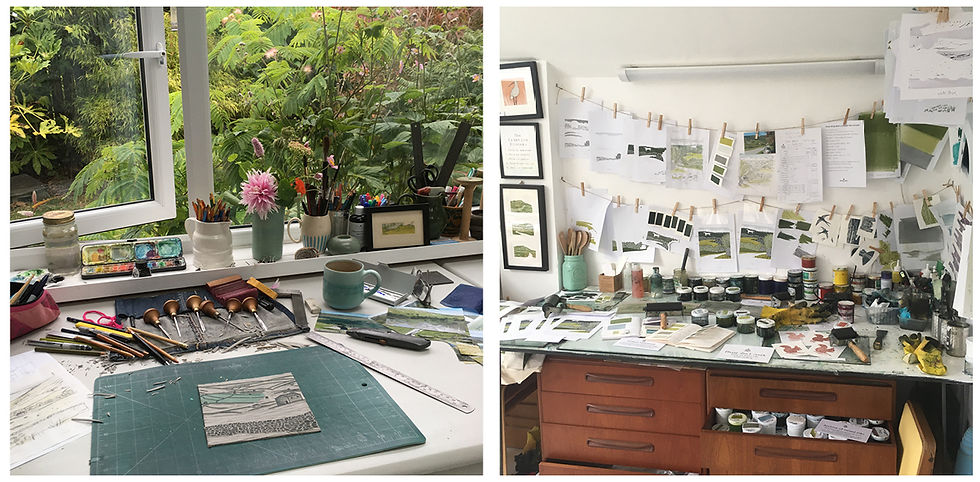
In March 2017, I converted my garage into a bright, light, warm, inspiring workspace. Back then, I’d lived here for 10 years and had always dreamed of making better use of the space.
Redundancy money allowed me to convert my garage into a light, airy, insulated garden studio. I live in a quiet suburb of York, with a view of Holgate Windmill.
I love the quality of light, even on the greyest day. I have windows overlooking my garden, so it brings the outdoors in. It’s such a relaxed place to work. Listening to birdsong is quite idyllic. Find out more about my studio makeover here.

Learning new linocut techniques
In 2017, I started experimenting with making multicoloured prints using the multi-block technique. Usually, a separate lino block is carved for each colour layer within a linocut print.

It takes a lot of planning to ensure the registration of each lino block line up when printed. I’m very mathematical and enjoyed pattern cutting at fashion college, so I guess I use a lot of those skills. Now, I mainly use the multi-block method to create my linocut prints.
Creative self-doubt and growing self-confidence
I’ve learnt to stand back and walk away from my designs when I first print them and let things settle for a few days. Like many creatives, I think I can be my worst critic!

York Open Studios
I applied for the 2017 York Open Studios but sadly wasn’t accepted. I applied the following year and was accepted, taking part in my first event in April 2018.

I’ve applied and taken part each year since then, as well as hosting my own open studio events. It’s a wonderful opportunity to meet people and share how I create my linocut prints. Find out more about my latest exhibitions here.
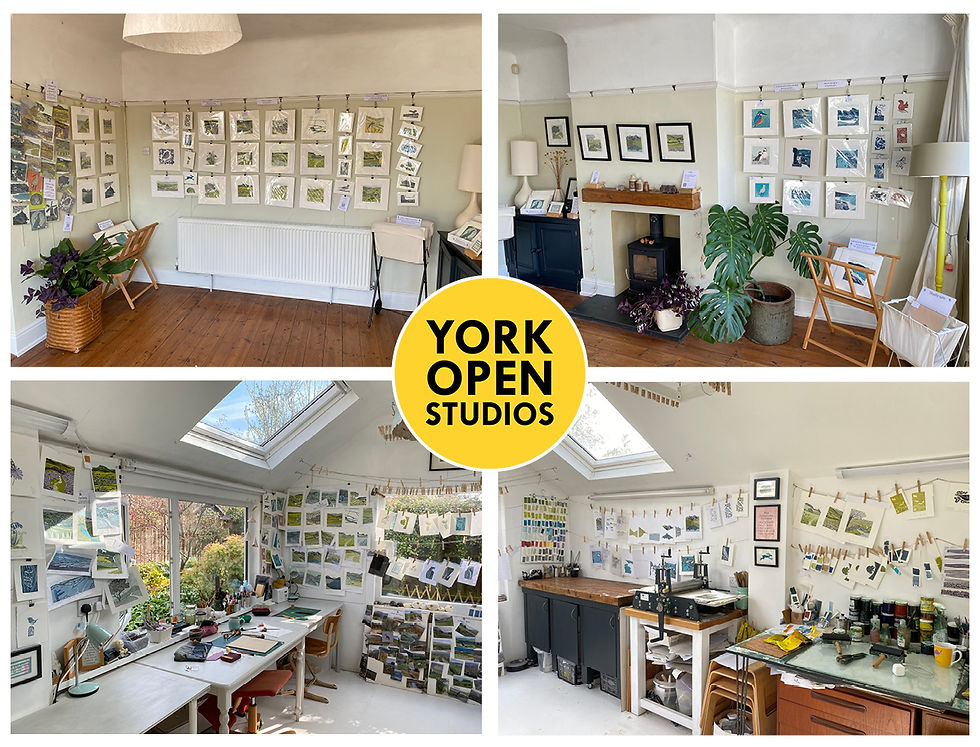
I also take part in and exhibit at the York Printmakers Print Fair each September.

Sharing a passion through linocut workshops and online courses
I wanted to inspire others to make more time for a creative hobby, and in July 2017, I started running linocut workshops from my York Studio.
I teach small groups of four, so everyone gets lots of one-to-one attention. I thoroughly enjoy teaching them. The look on people's faces when they peel back the paper from the lino block for the first time is an absolute joy, even more so when someone has started the day saying they’re not arty or can’t draw.
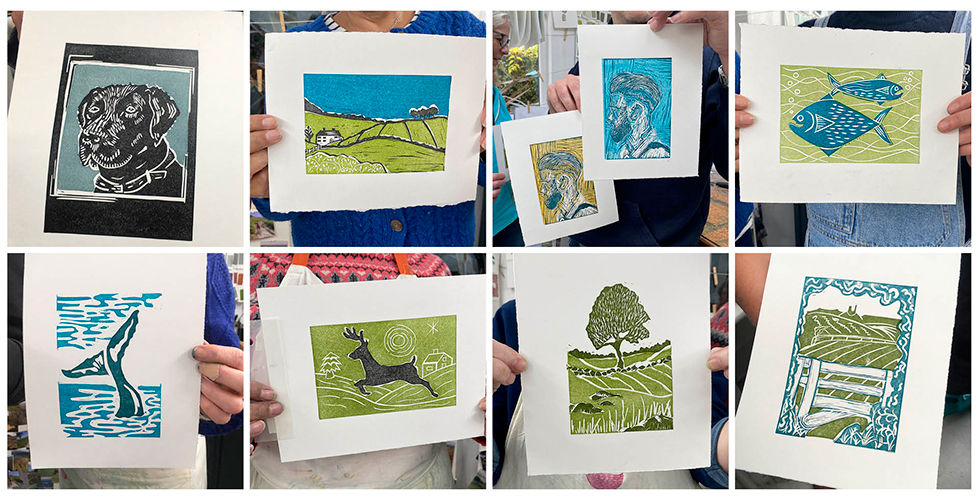
Initially, I taught beginners through my introduction to linocut workshops. Participants, learn how to use lino tools to create various marks and print them. With my background so strongly rooted in design, I love helping evolve their ideas from a photo or inspiration image into a sketch and a design that works well for lino print.
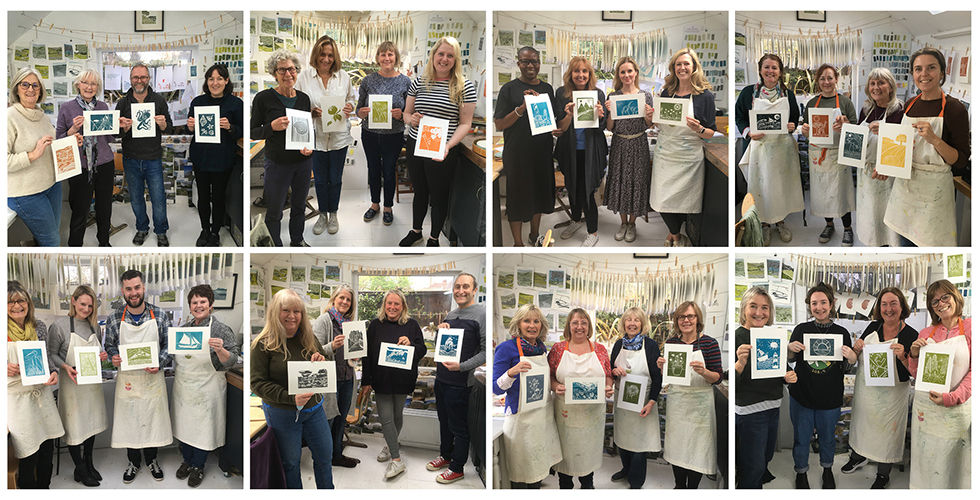

I now offer follow-on workshops in which participants learn to make multicoloured linocut prints using either the Jigsaw or Multi-block linocut method. I have more ideas for different lino print workshops, so watch this space!
Find out about my linocut workshops here.

Adapting during the pandemic: Teaching online
In March 2020, the pandemic lockdown meant everything came to a standstill overnight. Events, exhibitions and workshops were cancelled and postponed. Graphic design work dried up, and I had to adapt quickly.
The Design Trust launched an online course called Learn How to Teach Online, which was invaluable. The approach to teaching online is different.

I spent another 3 months writing, filming and editing my first online course. I had a wealth of experience to draw on from the in-person workshops I’d been teaching.
In July 2020, I launched my first online linocut course, “Beginners' Guide to Linocut printing”.

In May 2021, I launched my second online course, “How to Make a Multi-block Linocut Print”.

I continue to teach online, with students joining from all around the world. I host monthly Zoom Q&As for my students, and it’s been a joy to help so many people discover the craft of traditional printmaking.
Find out more about my online courses here.
Adapting during the pandemic: E-commerce online shop
Until the pandemic, I’d focused on selling my original prints through local art galleries, print fairs and events. With all these being cancelled, I was stuck.
I built my online shop and to my surprise, realised that people all over the country wanted to buy my lino prints of Yorkshire.
See my online shop here.


Alongside my online shop, I now continue to take part in two main events a year, York Open Studios in April and the York Printmakers Print Fair in September.
Becoming a full-time professional printmaker
The challenges I faced during the pandemic became the silver lining. Adapting my business during the pandemic was a success, and I realised I could make a living solely as a professional printmaker.
As the world returned to normal, I decided to leave graphic design behind and hand over my clients to a friend who’s a graphic designer, so I could focus solely on printmaking.

Commercial commissions
In terms of timelines, I’m going back a bit here again.
In December 2018, I was contacted by a graphic design agency about creating a series of 12 linocut prints for the National Trust’s Sutton Hoo. These were to be used, and still are, across a range of marketing materials. The curlew linocut print has since been used on gift ranges for the National Trust shop too.

In addition to the National Trust project, I have been privileged to work on several commercial commissions. Two of my favourites have been:
In 2019, Jim Leary commissioned me to create a series of 10 linocut print illustrations for his forthcoming book, Footmarks: A Journey into our Restless Past.
In January 202,2 I was commissioned to create artwork for The Rawcliffe Bridge Award for Sustainability. The illustration is composed of 16 individual linocut prints. Each quadrant of the plate depicts a season in the farming year and the natural farming cycle.
Read more on my commissions page.

Licensing
In addition to commissions, I license linocut prints for book covers, homeware, interiors, and editorial projects.

It’s quite a privilege to have your art chosen for the front cover of a book and an absolute delight to see it in print!
Read more on my licensing page.
Launching my first book!
In August 2023, I was approached by The Crowood Press to write a book on making linocut prints. I was blown away!
I’m proud to have launched my first book, Printing Birds and Wildlife in Linocut, on 24th February 2026.

It took me 20 months to write, make the linocut prints, photograph each step, edit it, and have friends proofread it. As I went along, I laid it out in line with Crowood’s in-house style and formatted it as I wanted it to appear in the book, to understand how it would visually look to the reader. I’ve poured my heart and soul into it.


In May 2026, I handed my 42,000-word, 660-photograph manuscript and layout to my publishers. Since then, it’s undergone several rounds of proofreading and has been laid out by a professional typesetter.

My book covers all the basics you need to make linocut prints, from planning designs to carving techniques, mixing colours, and printing. Plus registration, jigsaw prints, reduction prints, multi-block linocut prints, stamping with lino blocks and printing on fabric.
Inside the book, you’ll find 15 newly created linocut prints of birds and wildlife, along with a selection of favourites.
Read more about my book and where to purchase a copy on my book page.
What next?
I often get asked what's next. I find that a tricky question. I’ll always have drive and passion to learn more and move things forward, but I love the mountain I’ve climbed over the past 10 years, and I’m so proud of what I've achieved in that time.
I wear many hats while running my creative business. As well as making linocut prints and teaching workshops, I handle the marketing, my website, and the filming and editing of my online courses, mount and pack all my orders, take part in exhibitions, and do most of the photography.

It’s important to me to have a sustainable business, one in which there’s a balance between my work and my personal life. Spending time in nature not only inspires my work but also brings me so much joy and well-being. It’s also important to me to create new print collections and teach with quality and integrity, inspiring and encouraging others.

I’d like to create linocut prints of so many places and views. Yorkshire always holds my heart, especially the Yorkshire Dales. I’ve got lots of ideas from inspiration trips to Northumberland and Scotland, too. I also have plans for new workshops and courses up my sleeve, too.


I just love what I do, just as it is.
Having said all of that, I’m always open to ideas!
I hope you’ve enjoyed reading my story. I hope I’ve maybe even started that seed of an idea or created space for more creativity and nature in your life.
Michelle
About the author
Michelle Hughes is a North Yorkshire landscape artist. Much of her work depicts the Yorkshire landscape and the Yorkshire coast, including the Yorkshire Dales and the North York Moors.
Michelle loves exploring the British countryside by bike or on foot, camera in hand, capturing ideas for her next prints. Back in her garden studio, Michelle creates simple yet stylised silhouettes from her photographs and hand-carves them into lino. She handprints with an etching press, using oil-based inks to create tonal blocks of colour. Michelle’s original linocut prints are limited editions.


Comments